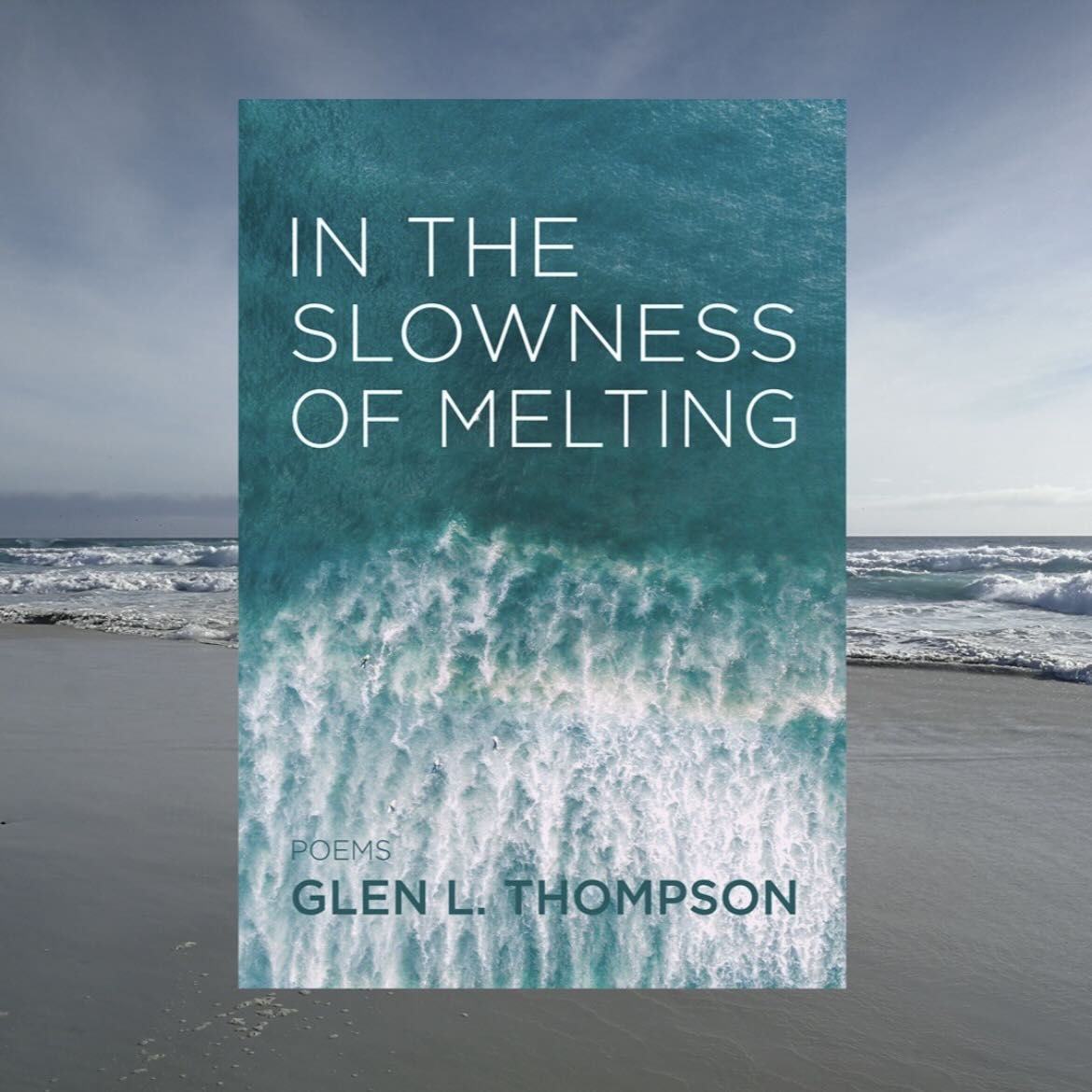
The 1st September will see the launch of my debut poetry collection, In the Slowness of Melting published by Karavan Press (2026).
An Extract
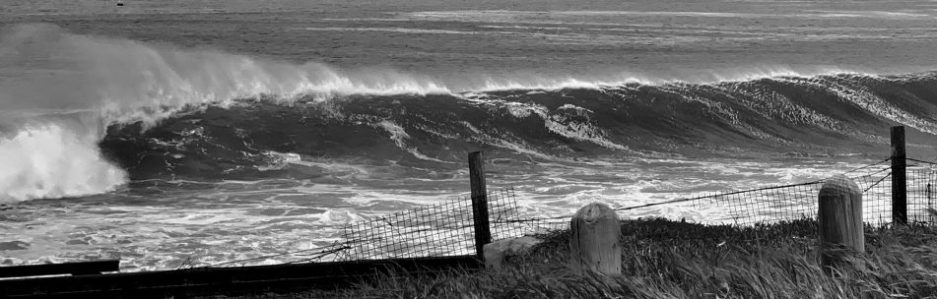
Paddling
to what pleasure?
sporting hope in dying
waters

From the poem: "Paddle Action"
About the Collection
In the Slowness of Melting is a collection of lyric poems that echo the waves in form and reflect in content on surfing, the beach, the ocean and our planet. Moving between the past, present and future, the collection registers internal and external shifts of focus to foreground change and a sense of loss. It reflects on our social world and seeks a more utopian future in the face of our climate crisis. The book is eco-poetry – or rather, cli-poetry – infused with a surf goth aesthetic, presenting a sunburnt disposition while thinking with/in the Anthropocene.
The collection curates poems I have penned over a few decades, but mostly from the post-Covid-19 period. The poems provide me with a voice I am not able to include in my historical writing on surf culture – a poetics that offers a personal preface to my forthcoming non-fiction book. Many of these lyric poems historicise surfing or the beach and reflect on sea-level rise and climate change to frame a poetics of our planetary climate crisis.
The book launch event details are available from Karavan Press here. Image by Karavan Press.
The Deep Duck Dive Podcast has three more episodes available to listen to. Co-hosts Karen Graaff and Glen Thompson chat about hydrofeminist and critical surf studies themes in surfing in these episodes: While we focus on surfing in South Africa and Africa, we also talk to global trends in surfing as a sport and lifestyle.
Season 1, Episode 5: Queering Surf Space – in this last episode of Season 1 we discuss the development of the current heteronormative culture in mainstream surfing, tracking its historical connection to colonialism, Christianity, and capitalism, and how that’s resulted in a space that’s often very unwelcoming for anyone who isn’t cisgendered and heterosexual. We then look at how queer surf groups have developed their own safe spaces, as well as how most mainstream surf organisations have failed dismally to do this. Case in point: we end with a short note on the WSL’s controversial decision to include Abu Dhabi as a stop on the Championship Tour in 2025, and what it says about their commitment to diversity and inclusion.
Season 2, Episode 1: Every Cape Town Surfer Has Feels About Muizenberg – we start Season 2 with a focus on Cape Town’s beach central, Muizenberg Beach. Love it, hate it, ambivalent, only when desperate, all-time favourite – every Cape Town surfer has an opinion on Muizenberg. In a bit of a break from our planned episodes, we’re starting what will (hopefully) be a mini-series chatting to local surfers about Muizenberg – their history and experiences at the beach, and their thoughts, feels and opinions about it, personally or in the context of surfing more broadly – in South Africa or globally. To kick things off, we chat about their own histories and experiences of surfing at Muizenberg, what they like and don’t like (spoiler alert: Karen likes it more than Glen), some history of the beach and area, representations of Muizenberg in films, TV shows and academic writing, and its use as a site for contests and as a drawcard for Cape Town tourism.
Season 2, Episode 2: Surfing About Comix Art with Andy Mason – In this episode, Glen interviews Andy Mason about his latest underground comix, Apocalypse WOW! Revisited (2025). While the starting point may be surfing and Muizenberg Beach in Cape Town, South Africa, the episode covers a range of topics beyond the beach, including how the past, present and future South may be represented in comic art.
Listen to all The Deep Duck Dive Podcast episodes here.
Three more episodes of season one of the The Deep Duck Dive Podcast are now available to listen to and we (co-hosts Karen Graaff and Glen Thompson) paddle out into the waves of social and historical matters relating to surfing.
Episode 2 is on the topic of The Waves Don’t Discriminate. In this episode, we discuss the issue of fairness in sport, and how a term that sounds neutral is in fact heavily politicised. We start with the definition of fairness in sport generally and then turn to fairness in surfing. The episode addresses the bans on trans women in sport, including surfing, and look to the gender politics behind those bans as well as the attempts by sporting bodies to use policies to regulate transgender involvement in sport. Listen to episode two of the podcast here.
Episodes 3 and4 is a two-part survey the history of surfing in Africa. In Episode 3: History of Surfing in Africa Part 1: The Colonial Archive we focus primarily on the history of surfing in West Africa, which has colonial records of African aquatic activities. This history draws on the historical work of Kevin Dawson which explores, and reclaims, West African aquatic practices and we also speculate on what other historical sources scholars could look to when opening up the archives to find evidence for surfing in the past elsewhere along the extensive African coastline. We focus the period from the early modern period (c. 1500) to the beginning of the twentieth-century (c. early 1900s). Listen to episode of the podcast here.
In Episode 4: History of Surfing in Africa Part 2: The Modern Era we focus on surfing in Africa during the modern era, from c. early 1900s to the present. We cover the topics of surfing and the British Empire and indigenous African surfing practices in West Africa before 1945, the era of “surf discovery” in Africa in the Sixties and Seventies, and then the diffusion of surfing through the processes of surf tourism, non-profit led social development, and sportisation in Africa from the 1990s and 2000s – taking the story up to surfing’s entry into the Olympics in the 2020s. Listen to episode of the podcast here.
Listen to all The Deep Duck Dive Podcast episodes here.
Announcement: Co-hosts Glen Thompson (Research Fellow, History Department, University of Stellenbosch) and Karen Graaff (Research Fellow, Women’s and Gender Studies, University of the Western Cape), academics and surfers based in Cape Town, South Africa, have launched The Deep Duck Dive Podcast – a public pedagogy and public scholarship podcast engaging with the oceanic turn in the global South by focusing on issues that matter within surfing as a lifestyle sport.
While the podcast has been a work in progress for some time, see our journal article in Critical Studies in Teaching and Learning published open access here in 2023 for our documentation of our approach to scholarly podcasting and thinking with/in surfing, we launched the podcast on 30 September 2024. We aim to publish new episodes every two weeks.
Season 1 of the podcast opens with a pilot episode introducing the podcast and ourselves. Episode 1 is titled: Surfing history – Why History Matters. The theme for the first season is, What could surfing (be)come, and makes use of hydrocolonialism, hydrofeminism and critical surf studies perspectives to explore the following topics: surfing’s colonial history, the history of surfing in Africa, surfing and social change, discrimination and the waves, inclusive surfing spaces, and surfer environmental consciousness. In these episodes we seek to challenge and subvert surfing’s normalisation of certain raced, gendered, classed, and ableised bodies; both in past and in the present and so re-imagine surfing’s future through a social justice lens as decolonised and inclusive sporting and leisure activity. A Season 2 of the podcast is planned for 2025.
Recently, Kim Feldmann of Surf Simply interviewed with me about some of the main points of my research on surfing ans politics in South Africa during the early months of the COVID pandemic.
This is from the introduction of the interview, titled “Unridden”:
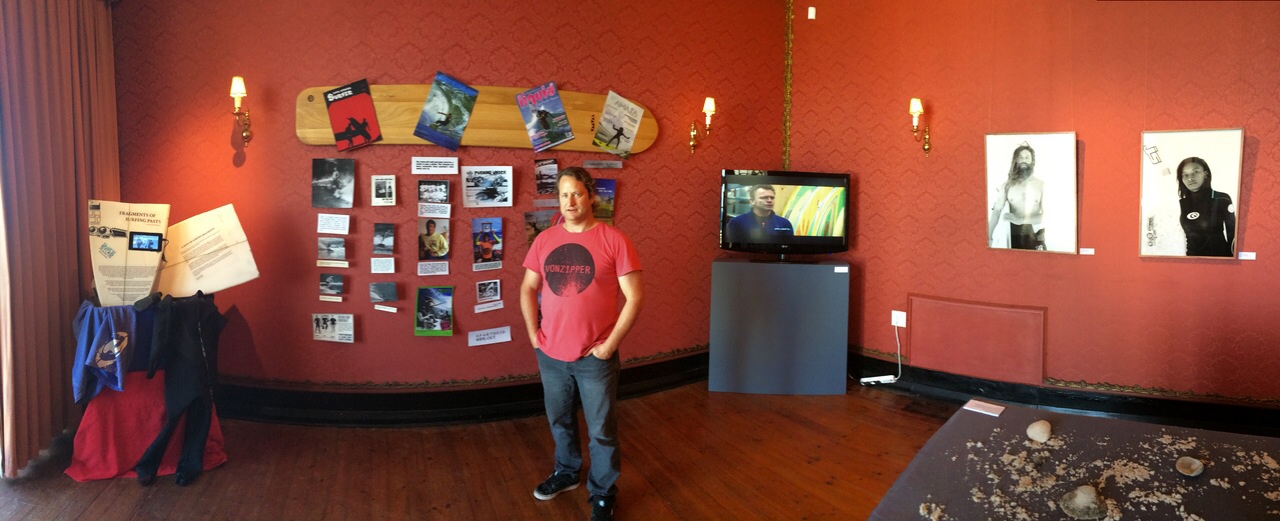
“Fragments of Surfing Pasts” art installation, Casa Labia Gallery, Muizenberg, 21 September 2014. Photo: Cobus Joubert
The Beyond the BeachExhibition opened opposite from the waves at Muizenberg’s Surfer’s Corner at the Casa Labia Gallery on Sunday, 21 September and ran to 21 October 2014. Curated by Paul Weinberg, the exhibition features several photographers whose work re-imagined the beach and shoreline of False Bay as space for ways of seeing the fluidity of identities, emotions, spaces and aesthetics associated, evoked or juxtaposed to the “beach” as place and concept. I was invited to participate in the exhibition and create an art installation that critically explored South African surfing histories (see note below for more details).
Exhibition summary
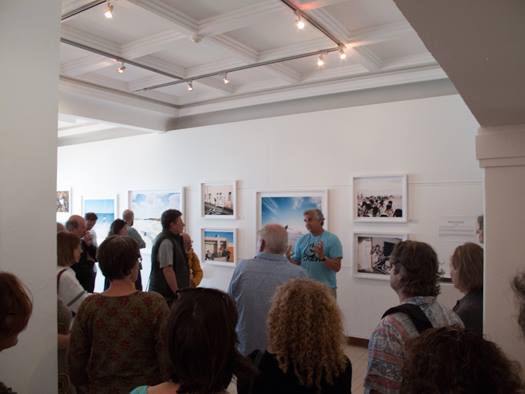
Paul Weinberg talks to the exhibition themes at the Walkabout on 12 October 2014. Photo: Casa Labia
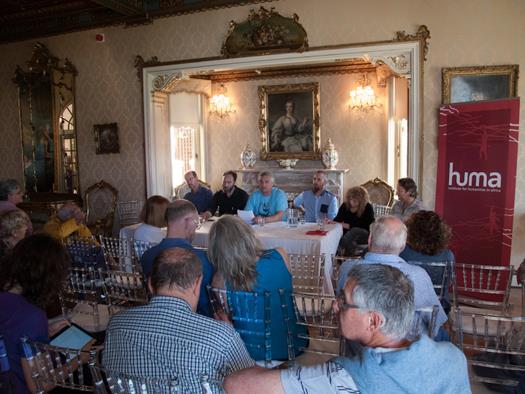
Exhibitors on display: HUMA hosted panel discussion on the Beyond the Beach Exhibition, Muizenberg and the raising questions about the beach as a space opening the possibility of inclusivity and belonging in post-apartheid South Africa. Held in at the Casa Labia ballroom, 12 October 2014. (L to R: Rodger Bosch, Sean Wilson, Paul Weinberg, Robert Hamblin, Jenny Altschuler and Glen Thompson. Not pictured, Sandy Worm, who is based in Germany). Photo: Casa Labia.
A note on the “Fragments of Surfing Pasts” art installation
Surfing pasts becomes somewhat knowable through traces, found fragments providing a view of what happens beyond the beach in the waves. This art installation was a reflexive review of my place within my studies of South African surfing history. Part summation of my doctoral dissertation in History (the exhibition run during the final month of my writing up of my dissertation), part visual representation of some of the key sources and themes informing that historical study, this installation was a becoming for me as a surfer and historian, a space for me to speak as a cultural practitioner to my interpretations of the beach and surfing’s historical place therein. The selections from the magazines on display come from independent South African surfing magazines no longer in print, South African Surfer (1965-68), Offshore (1987-89), and Liquid Girls (2005-6), or in the case of Amaza (2012 – ), currently in print but not widely available. All found a publishing home in Cape Town; South African Surfer moved from Durban for its last issue. The earlier magazines folded due to market pressures, Amaza is published by Waves for Change, a local non-profit organisation that uses surfing for leadership training and social development for at-risk youth from Masiphumelele and Khayelitsha townships in Cape Town. Each magazine reflects turning points in South African surfing history and points to the shaping of the diversity of surfing identities in the present. South African Surfer provides a record of the Sixties surf boom in the longboard era, Offshore reported on non-racial surfing under apartheid, Liquid Girls made girl and women surfers visible in a market over-determined as youthful males, and Amaza brings to the fore the lives of black surfers and emergence of township surfing. Framing the surf magazines, the broken surfboard speaks of the how the shortboard is no longer the only way of finding pleasure when riding waves. It was provided by Share the Stoke Foundation South Africa, which repairs and re-deploys surfboards into local surfing development programmes. This surfboard was beyond repair and was last used at the Surfshack Surf Outreach Project in Muizenberg. The wooden Alaia Needle surfboard, shaped by Muizenberg based WAWA Wooden Surfboards, guides the chronology of the installation, from the Sixties to the present. It also references surfing’s precolonial Hawaiian past, that surfing has traveled the globe in the modern era, and gestures to the future of surfboard shaping in seeking alternative and environmentally-friendly materials to surfboards made out of petrochemical based epoxy, polystyrene, polyester and polyurethane products. The UCT documentary film, Berg Boys (2013), brings Muizenberg into focus as a space for passing on surfing styles and know-how from a surf coach to a young grom in keeping the surfing stoke alive. The film brings to the fore the role of surf tourism in providing employment to black surfers and provides a view of how surfing keeps youth off the streets and in the waves.
Reading surfing histories during the exhibition Walkabout. Photo: Paul Weinberg
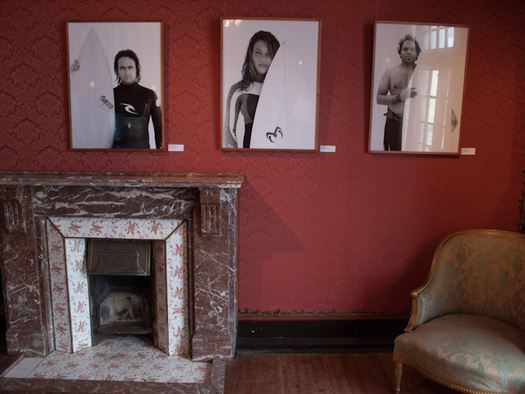
My installation shared a room with Sandy Worm’s portraits of some of Muizenberg’s black surfers, titled: Black People Don’t Surf. The details of this photographic project, and the others that were on display at the Beyond the Beach Exhibition are detailed in the catalogue archived on the Casa Labia Gallery website.
Black surfers at Muizenberg: some of Sandy Worm’s portraits. Photo: Paul Weinberg
I presented a research in progress paper entitled “Transforming Surfer Boys: A Cultural History of Zulu Surfers in South Africa, 1965 to 2013” in the panel on Conflict and Leisure at the Historical Association of South Africa (HASA) Biennial Conference in Durban on Friday, 27 June 2014. This working paper on black surfing histories in South African forms part of my doctoral study on gender and politics in the history of South African surfing culture.
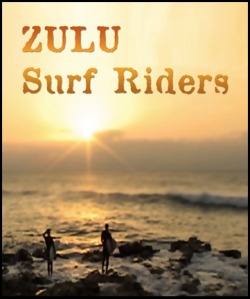
Surf film: Zulu Surf Riders (2008)
Summary of the paper
A cultural history of black surfing disrupts the whiteness, but not the masculine ethos, of surfing in South Africa. For Durban, two films have foregrounded Zulu surfers, the feature film Otelo Burning (2011) and documentary film Kushaya Igagasi (2013), translated as “Hitting the Waves”. In seeking to contextualise these contemporary formations of youthful black, male surfing subjectivities, this paper sets out a genealogy of Zulu surfers in surfing magazines, surf industry advertising and films featuring surfing (surf films, documentaries and feature films) from 1965 to the present. These sources provide an archive for a postcolonial reading of established (mediated, commercialised and organised) surfing culture’s appropriation of Zuluness during years of beach apartheid to affirm white surfing’s cultural distinction and difference in terms of race, class and gender. In the post-apartheid era, a discourse of surfing development and national sports transformation re-shaped views of Zulu surfers from that of athletic tokenism to social inclusion in the waves. Nevertheless, race trouble (the presistance of racial inequality in the everyday despite a discourse of tolerance) and contested masculinities at the beach have remained a persistence of the past. From the early 1990s, the voices of Zulu surfers in KwaZulu Natal can also be found in the surfing archive. A changing cultural politics has made possible an agency for Zulu surfers to accommodate, subvert or re-appropriate established surfing’s representations of “the surfer”. While this self-fashioning may be driven by a desire for social mobility, they have emerged, especially in the 2000s, out of clubs or social development programmes, inclusion within surf teams, brand sponsorship and media attention. The Africanisation of South African surfing culture, expressed at times as township surfing culture, is addressed by exploring the local and global processes of surfing lifestyle consumption among Zulu surfers in Mzansi (the South).
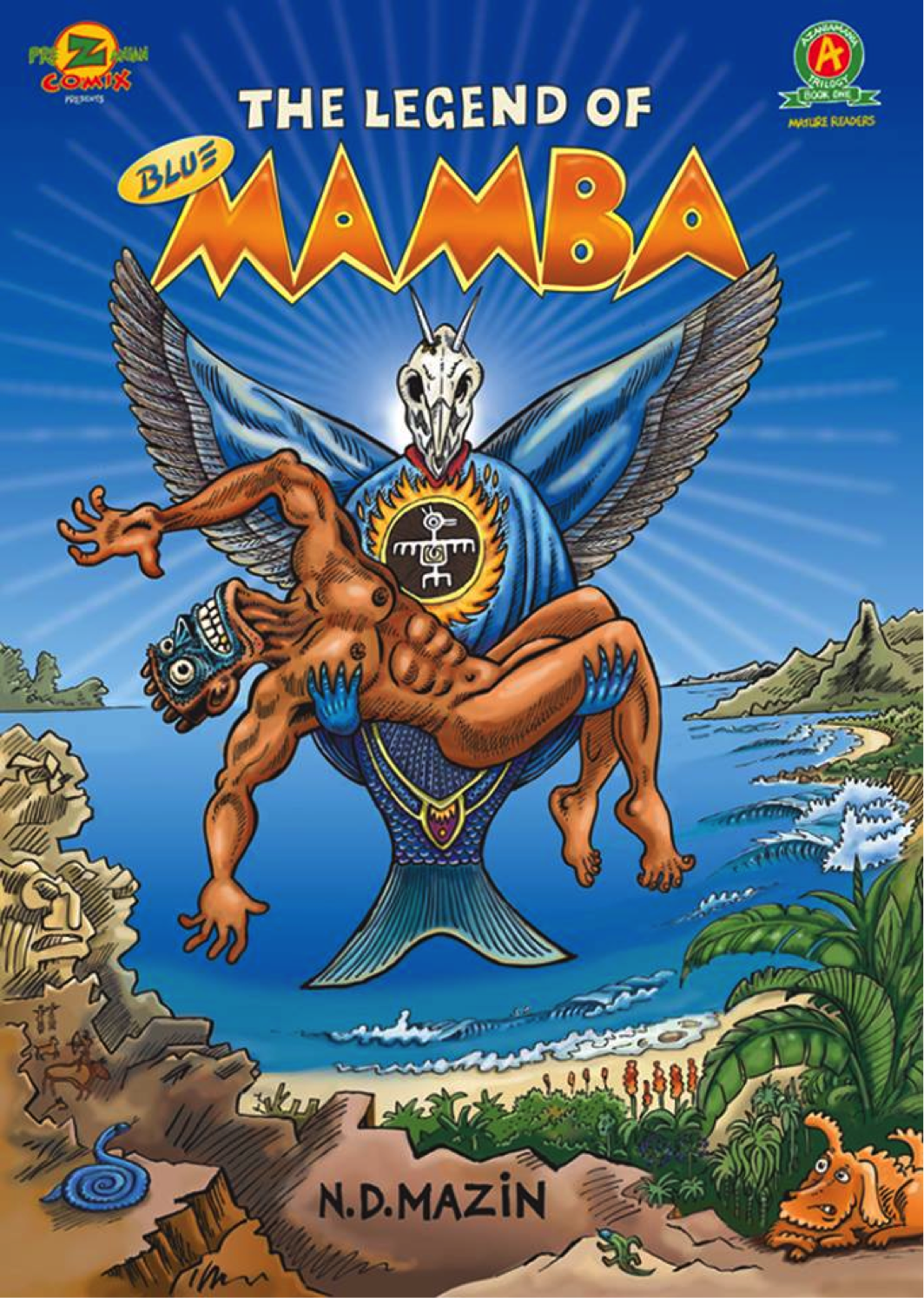
I was in conversation with comix artist Andy Mason (aka N.D. Mazin) at the launch of his graphic novel The Legend of Blue Mamba at the Homecoming Centre in Cape Town during the Comic Fest at the Open Book Festival, 8 September 2013.
The genesis of the graphic novel was in the comic work produced and published in various print, surfboard art and online since the mid-1990s. The first appearance of the Blue Mamba character was in the first issue of the now defunct African Soul Surfer in August/September 1995. This was my first encounter with the Blue Mamba’s subaltern surfing adventures.
My interest in The Legend of Blue Mamba is how Mason takes a countercultural and environmental activist surfing identity and creates an anti-brand through Blue Mamba in a surfing world where lifestyle consumption drives how the image of surfers, and surfing, is manufactured and maintained by the surf industry and surf media. The Legend of Blue Mamba is a cautionary tale of the commodification of the surfing dream.
Other themes addresses in conversation were: the character of Blue Mambas as “an empty signifier of meaning and identities”; how in the post-apartheid era progressive cartooning has taken to satirical critique of brands as they represent and determine lifestyles today; how surfing can be used to offer critique to consumer and highlight environmental injustices; why the Sixties is still politically and culturally relevant today; representation of the “author” in cartooning, especially as “a character is not the author”; the idea of parallel narratives in comics and how that can drive the storytelling; and how the graphic novel draws from the realism of the experienced world adds to the comic imagination.
I presented a research in progress paper entitled “From Femlins to Saltwater Girls: Sport, Lifestyle and Femininities in South African Surfing Culture, c.1965 to the present” at the Stellenbosch History Department Seminar Series on Wednesday, 24 April 2013. This paper was then presented on Saturday, 29 June 2013 at the 2013 Southern African Historical Society Conference held in Gaborone, Botswana. This working paper forms part of my doctoral study on gender and politics in the history of South African surfing culture.
A further iteration of this paper was presented at the Institute for Humanities in Africa (HUMA) at the University of Cape on Thursday, 28 August 2014. This work in progress paper was titled: “From Femlins to Saltwater Girls: Surfer Girls and Lifestyle Sport Consumption in South African surfing magazines, 1965 – present.”
Summary of the paper
Liquid Girls Surfing Magazine, cover of March 2006 issue.
This paper seeks to make visible the histories of women’s surfing in South Africa as a counterpoint to the persistent discourse that the sport of surfing is a male activity. It attempts a pro-feminist, new cultural history reading of the surfing archive taking into consideration both textual and visual sources to recover the representations, voices, experiences and agency of girls and women who surfed or continue to surf in Cape Town, Durban or elsewhere along the South African coastline from the mid-1960s to the present. This paper seeks to document how South African surfing femininities negotiated complicity within the gender order or, through a surfing identity, challenged the gendered nature of power in society and within surfing culture itself. It explores both the local and global iterations of surfing femininities as shaped by or shaping cultural, social and commercial processes. In particular, the role of surf magazine advertising is examined for how it maintained a youthful, sexy, athletic yet objectified heterosexual image of the “surfer girl” over several decades. In locating this study within the study of hegemonic femininities in southern Africa this paper explores the complexities of gender relations in the social construction of femininities: how these femininities were themselves historically contingent, fluid and contested by girls and women who surfed, constructed in relation to men in the surf and on the beach, located in relation to a discourse of a femininised ocean, and socially differentiated based on the culture of beach leisure and access to leisure time, sporting prowess, the nature of sportisation through organised sport, and the consumptive ethic of a beauty culture associated with the emergence and consolidation of surfwear as mainstream fashion. In short, in reflecting on the role of gender and lifestyle in South African surfing history, the conditions for the emergence in South Africa in the 1990s of the global phenomenon of the “Surfer Girl”, with its Californian and Australian roots, is considered within the context of the democractisation of South African society. Yet, this history also illustrates some of the limits of social and cultural change at the beach as women’s surfing in South Africa has largely remained a white sporting activity, despite the promise of change in the prominent roles of black girl surfers in the Hollywood DVD Blue Crush 2 (2011), set in KwaZulu-Natal and the eastern coastline, and the locally produced Amaza (2013) television series filmed in Muizenberg, Cape Town.
I presenting a paper on how black surfers have been represented in South Africa’s surfing print magazines since 1990 at the Work/Force: South African Masculinities in the Media Conference held at Stellenbosch University on 13th & 14th September 2012.
Summary of the paper
The idea of the “surfer boy” in the South African surfing imaginary is no longer primarily white, male and youthful although Zigzag (since 1976) and thebombsurf (since 2008) surf magazines continue to maintain that white, heterosexual hegemony within their textual and visual representations supported by surf industry advertising expenditure. Nor is surfing nostalgically looking back to the halcyon days of the Californian inspired Sixties and Seventies. Rather, through grassroots initiatives, surfing development programmes linked to organised surfing, and pressure from the national sport ministry, that same surf media and several surf movies are constructing the idea of surfing in Mzansi (the South) at established and emergent surfing centres along the South African coastline, such as at Durban, Mzumbe, Port St Johns Jeffreys Bay and Muizenberg, where black male surfers and white girl surfers are visible. In many ways it is the new possibility of these postcolonial surfing sites that have provided the greatest challenge to the historically white and male South African surfing imaginary and opens up possibilities for new male identities and gender relations on the post-apartheid beach and, through sporting and recreational practices, in the surf. This does not mean that the surf media is not without producing social tensions in what is said and not said (and what is seen and unseen) about race and gender. The former surfaces as race trouble in negotiating new identities that attempt to masked social fractures within surf culture. The latter shows fissures in the production of a white South African surfing masculinity historically used to supporting its dominance in society through a sporting practice. In these ways, the South African surf media provides a useful lens to critically explore competing masculinities within a marginal aquatic sporting tradition that point to social transformations on the beach in the years after apartheid.